It looks like you're using a small screen or mobile device! As an amateur dev, I can't guarantee this page will work on all devices.
You can attempt to view this page anyway, or head to this character's Toyhouse profile.
Winter, 1995. Rural midwestern America. On the cusp of graduating high school, Kaiana "Baj" Bajpur breaks their best friend's nose. Three months after their expulsion, their home burns to the ground. They go missing that night. When no one seems interested in finding them, their best friend takes on the case personally.
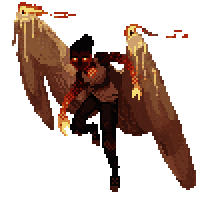
Baj, unknowingly, is tied to a phoenix. Whatever the universe, whatever the narrative, whatever the circumstance, it seeks to be with them. Shortly after their 18th birthday, it finds them.
Now possessed of flame and the ability to heal any wound, Baj stumbles into the hands of the Walter Memorial Library. The Library, interested in public safety and scientific progress, incarcerates them for four grueling years.
When the narrative brings their best friend, Fray, back into their life, they set themselves to escaping. With the help of another catalogued individual, they manage it, though not without a series of disastrous accidents (becoming suddenly lost in the middle of the Mojave among them).
What follows is a cat-and-mouse game, with the Library trying to reclaim its most dangerous assets. The trio of escapees has to contend with the fact that life will never be the same for any of them. And, despite the futility of the effort, they have to keep trying anyway.
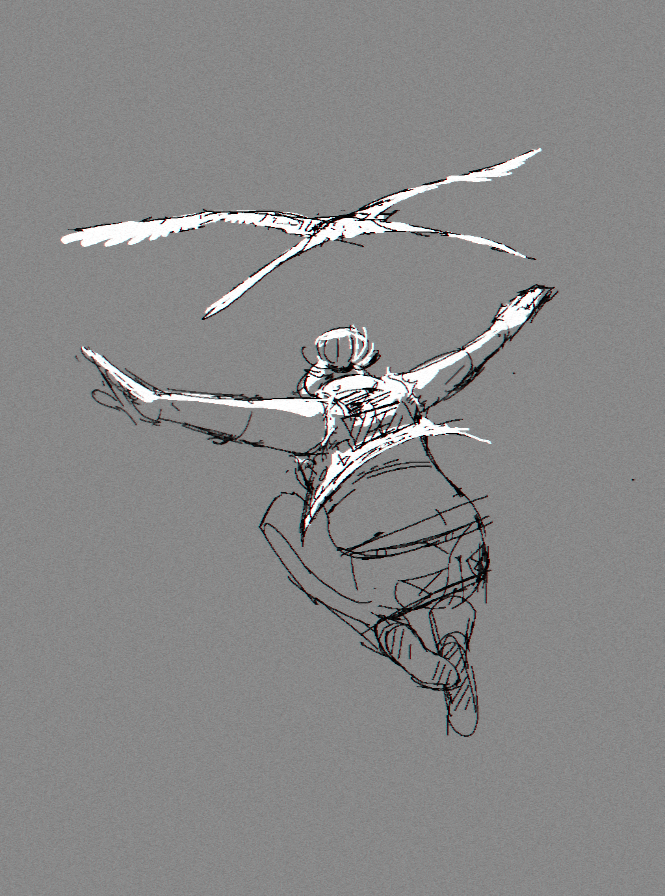
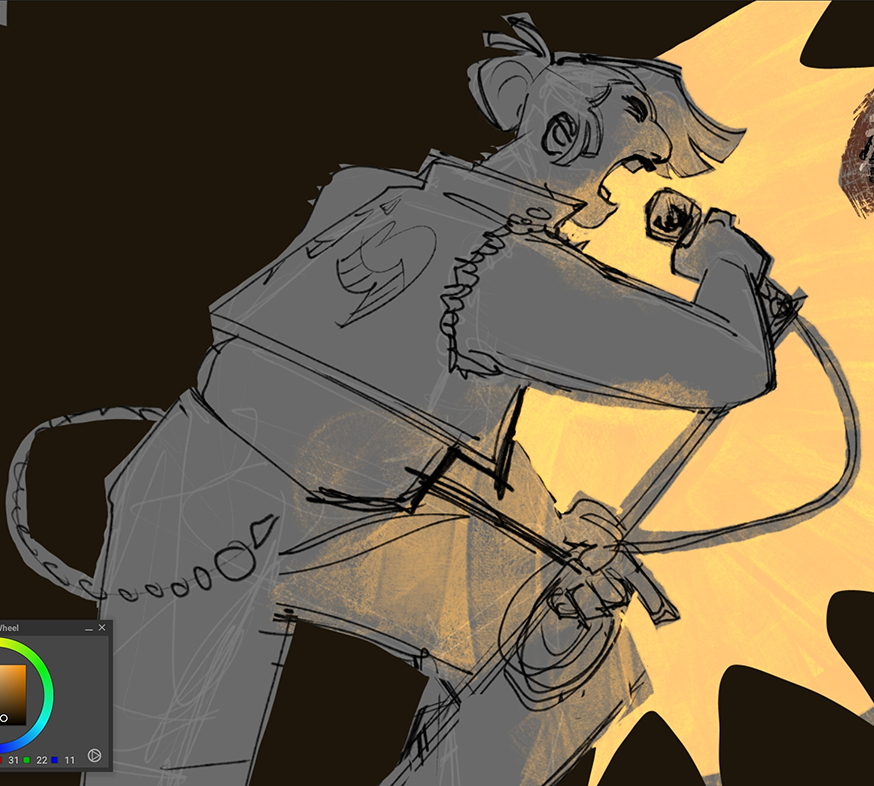
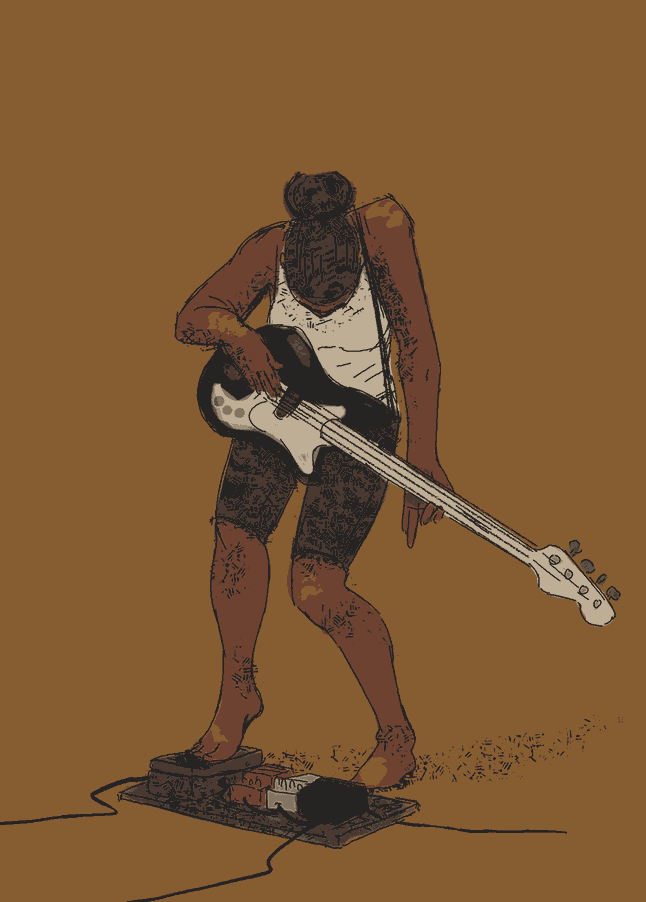
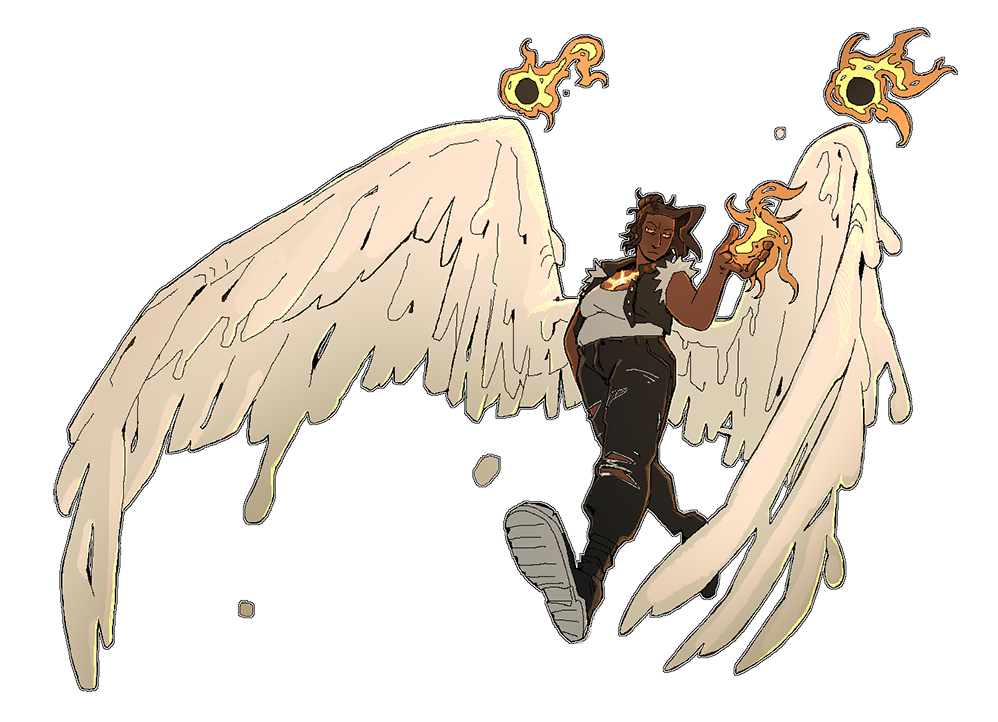
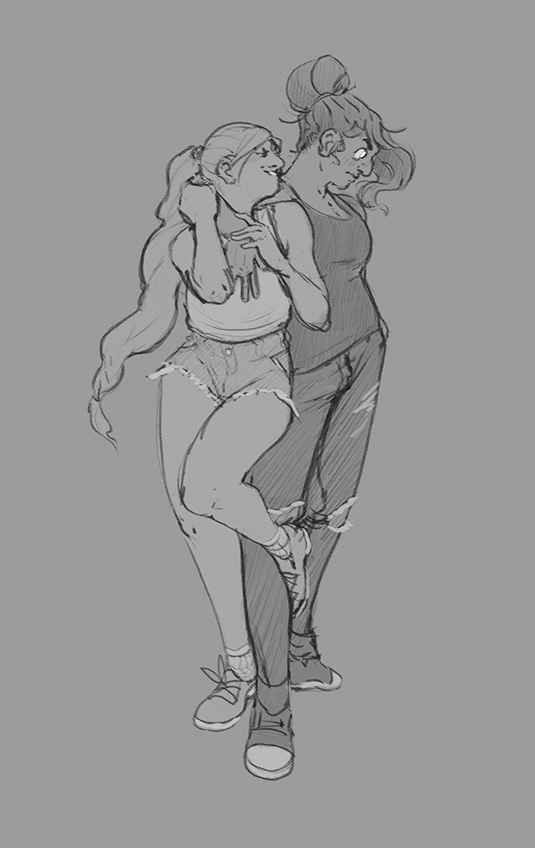
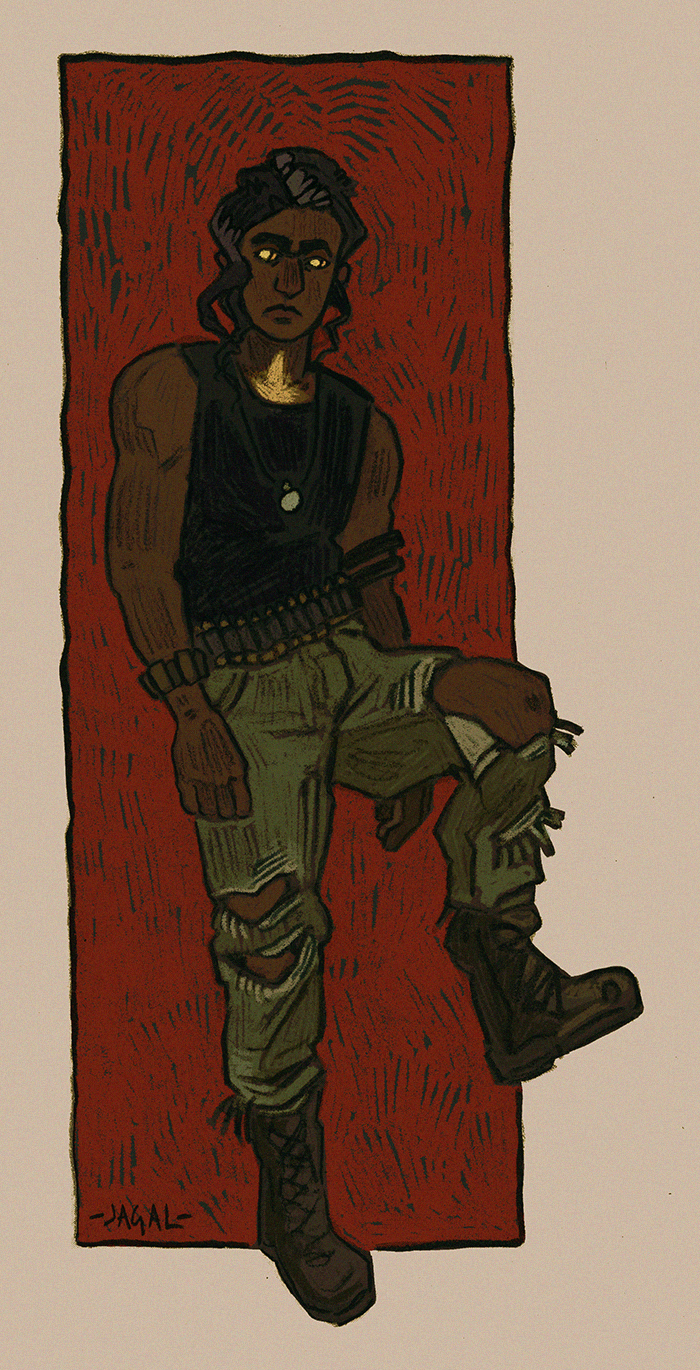
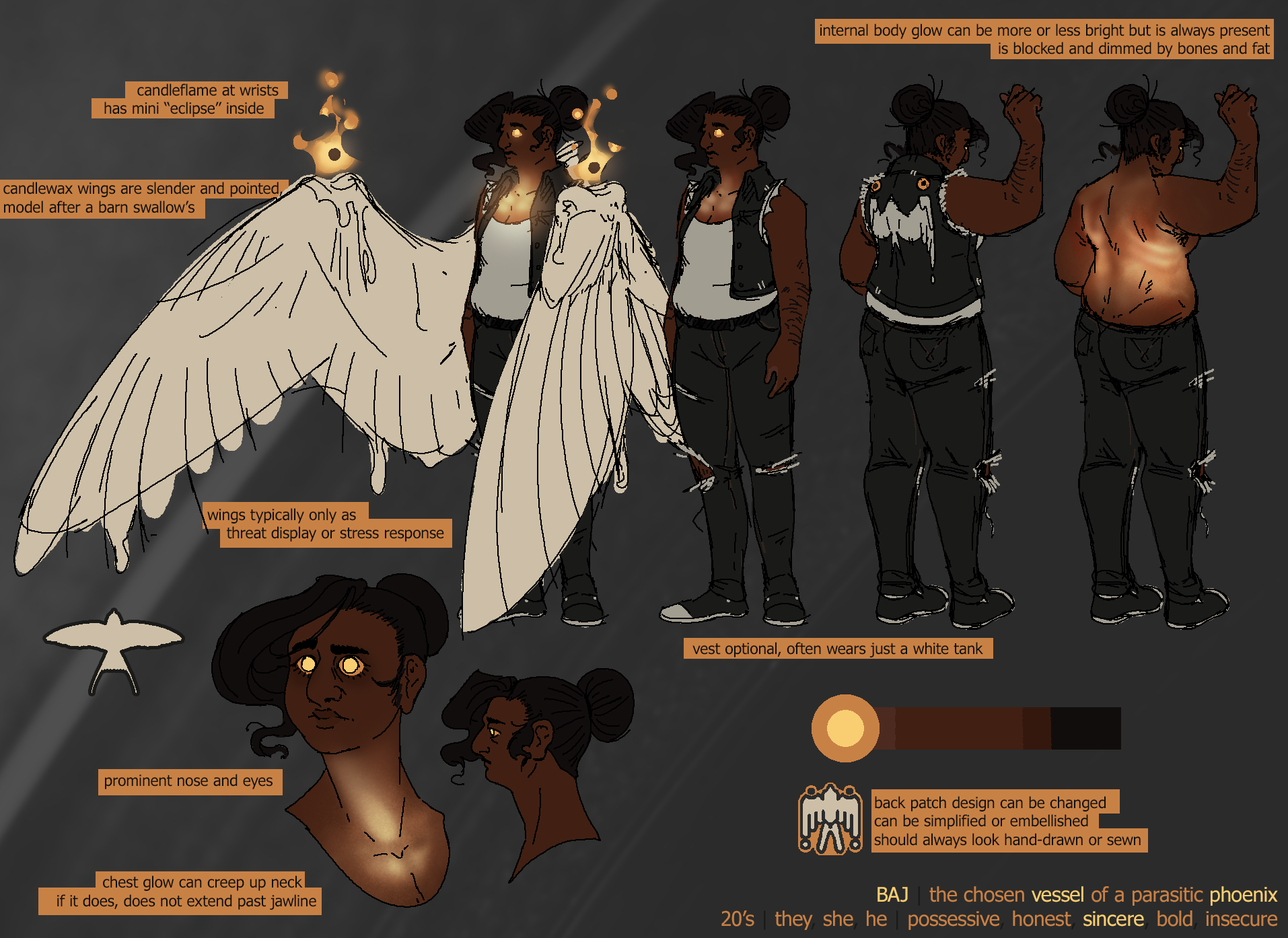
Dense, well-built bodytype. Short. Moderately athletic with a layer of fat. Neither bulky nor lean.
Dark skin with a clear complexion. Dark, moderately wavy hair. Hyperpigmentation around eyes. Eyes usually glow orange and yellow, a very dark brown otherwise. Prominent nose and eyes. Full lips. Face is rounded and youthful.
Hair usually worn in a loose, high bun. Clothing is typically masculine, vaguely grungy, and lacking in bright colors.
Anxious and easily put off. Clings possessively to the few people they’ve grown close to. Speaks quietly, but honestly. Abandonment, separation, and self-esteem issues. Extremely prone to sensory overwhelm. Often confused by, if not outright hostile to, social norms.
Often seems annoyed or bored in their affect. Good at telling when someone is lying to them, and are prone to calling the liar out on it. Doesn’t laugh often, but finds many things funny.
Can't recognize their own emotions in the moment. Takes a long time to come to any internal conclusions. Often feels alone, inhuman. Convinced that hurting the people they care about is inevitable.
Decisive, never impulsive.
Creatively driven. Prefers musical and artistic pursuits, with a deep appreciation for art as a means of communicating.
In their stories, Baj is a young adult who finds themselves suddenly host to a parasitic phoenix. Their story is one of coming to understand and accept their passenger, as an extension of accepting themselves.
Phoenixes, in this story, aren't driven by the same perspective, intentionality, or goals as a human being. They are driven by instinct rooted in narrative. They follow their hosts from story to story, world to world, life to life, driven by a narrative certainty. They know how the story is supposed to go, and they know their role in it.
Baj's phoenix, Ozzy, knows it is supposed to find Baj and it is supposed to love them. It is supposed to help them become the best version of themselves. A phoenix wants nothing more than to witness humanity, and Baj is Ozzy's viewport.
Baj, for their part, is someone who wrestles with being dehumanized and often misunderstood. Despite craving human connection, they have trouble seeing themselves as human. They feel lost without that connection, but have internalized that the way they connect is hurtful. They have selfish, possessive desires and deep insecurities. Baj feels doomed to hurt the people they care about and, in constantly worrying at the idea, denies themself the comfort they innately find in companionship.
Ozzy loves them for every perceived flaw. Ozzy, as a phoenix, wants to indulge in all humanity has to offer. Baj, subject to the hedonistic human impulses that they are, is the perfect protagonist for the story Ozzy knows it is a part of.
Baj's instincts, to hold and to own and to eat, align perfectly with Ozzy's desires. Their motivations end up being the same: take all that being human has to offer and enjoy it. Indulge in connection and sensation. Love and joy as human experience. Coming to understand that their drives are the same, that host and parasite desire the same thing, that desire is not inherently evil is how they both bloom.
They exist in brief summertimes of narrative overlap. They thrive in the story of they finding and knowing each other. When they inevitably must part (when the story ends), it's with the understanding that they will come to circle each other again. That's the way it will always go.
Personally, this idea of how a phoenix works was derived from my partners and I enjoying the creation of alternative universes for our original characters. The motifs and beats would remain, but relationships and environments swapped and played with. It became interesting to me to imagine Ozzy, circular as a phoenix is, as having a sort of "metatextual" perspective. Aware of every au, of every self-referential joke. Aware of its relationship to the protagonist. Aware that it's being written, and trusting in its authors.
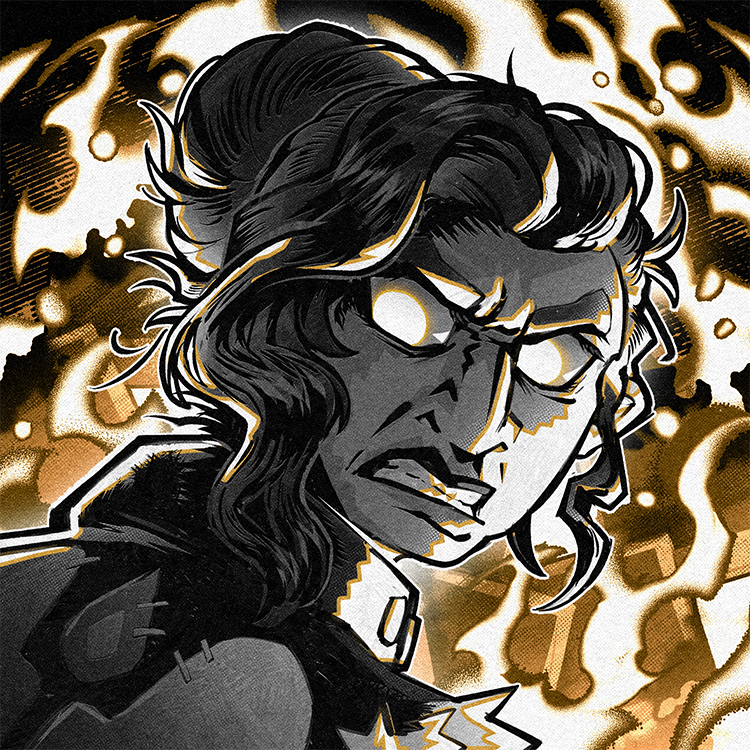
by corgi
"Miss Kaiana---may I call you Kaiana?"
Silence. Dr. Caleb Keane adjusts his pince-nez, and tries again. He leans into the microphone. The person across from him, a well-built young adult with long, dark hair and dark skin, is doing an excellent impression of a sullen teenager. They sit slouched in their chair, staring listlessly at a fixed point on the divider between them. It's like one of those prisoner communication stalls, but this one can withstand temperatures upward of 2,000 Fahrenheit.
"Miss Kaiana. I'm Dr. Keane, if you'd forgotten. How are you doing today?"
Their gaze slips slowly up until their glowing eyes lock onto his. The poison there is discomfiting.
Keane smiles sympathetically. "A poor question. I apologize. But that's what I hoped to talk with you about today, your quality of life." Kaiana goes on glowering, unmoved. "Is there anything we could get you, to improve your living situation? I want you to be as comfortable as possible during your stay."
Time passes.
"A conversation is a mutual thing, you know," Keane says. "But if you're already wanting to go back to your unit ..."
He shrugs.
He waits.
When they finally do speak, it's hoarse and low. Keane barely catches it. "I want," they say, "to go home."
"I'm afraid that's not possible at this time."
"Not possible," they echo.
Keane holds back a sigh. He feels for the kid---he does, truly. But the attitude is not making things any easier for anyone. Maybe some clarity is in order. "Do you remember being brought here?"
"No."
"Do you remember what led up to it?"
"No."
Keane taps his nail against the table. "You had wandered into a house and had some kind of mental break. You caused a fire. The resultant fire incinerated the entire building."
Their eyes widen fractionally. Good; he'd been aiming for that. "The occupants weren't home," he goes on smoothly, seriously, "but that is why you were picked up, and why you will stay here until further notice. You're a danger to others."
Kaiana's face contorts. It goes through several layers: confusion, horror, suspicion. "I don't remember doing that."
"We have footage, if you feel the need to see for yourself," Keane says, and the suspicion at once becomes worry. They shake their head.
"But," Keane goes on, "as I said. I'm here to discuss your living situation. I believe in carrots over sticks, when at all possible, and we're going to need your cooperation to help you get better. I understand you like music. I can get you some."
Slowly, Kaiana's tense outline relaxes, and Keane allows himself the smallest of smiles.
by corgi
These are the things Kaiana Bajpur knows: The cell is made of concrete, or something that looks like it. It is a twelve-by-twelve foot box. It's not quite five steps from side to side. You can get up to six if you go at it diagonally. There are two imposing metal fire doors, and no windows. The lights dim for what might be eight hours every night. They have been here for sixty-three days.
It might be sixty-four. Baj isn't sure.
Other objects in the cell include a metal cot with a mattress, pillow and blanket, a handful of vents (too small to climb through), and a partition with a toilet. There's a speaker and camera set into a box made of thick, clear plastic, mounted on the wall, too. Of these, only the pillow is of much interest. It's a nicer pillow than the circumstances would suggest is available. It has Donatello from the *Teenage Mutant Ninja Turtles* on it. The reasons for this are unclear. Baj certainly had not asked for a novelty pillowcase. Baj has asked for exactly one thing since their arrival in this place, and it has consistently been denied.
Like usual, today, Baj finds themself curled into a ball on the cot. They've been picking at a loose thread on the hem of their jumpsuit sleeve (dark green, itchy) and have succeeded in unraveling it about two inches in the hour they have been laying here, waiting.
The speaker crackles. "Miss Bajpur?" says a polite, male voice.
Baj does not move.
"Miss Bajpur, we need to transfer you to the observation room." With a hiss, one of the fire doors begins to grind open. Baj can see part of the chamber beyond from where they lay: a sparse box of a room barely bigger than their cell, one-way glass set in the far wall. Four huge speakers, almost as tall as Baj themself, stand encased in the same plastic as the small one in the cell. They dominate the room, easily dwarfing the metal chair bolted to the floor in the center.
The voice on the speaker asks, "Will you comply, Miss Bajpur?"
Baj closes their eyes. They do not move.
The speaker says, not unkindly, "I'm obligated to inform you that if you do not comply, we will transfer you manually."
This, finally, provokes a response. Baj levers up an arm, hand toward the camera, and extends their middle finger.
The fire door grinds shut again. The speaker falls silent. This is the worst part, the part after the warning. The waiting. Baj listens in the silence, trying to hear the hidden machinations that lay in the walls. They curl into a tighter ball and try to remember what it was like to be somewhere else.
Kchnk, goes something behind the walls, and the vents begin to hiss a familiar white smog. Baj pulls the blanket up over their nose and mouth, more than aware this will only prolong the inevitable. The gas will deep in eventually, and when it does it will paralyze them, fully, not just their limbs but their face, throat, diaphragm.
The plumes of smog drift gently toward them, and Baj prepares to suffocate.
Again.
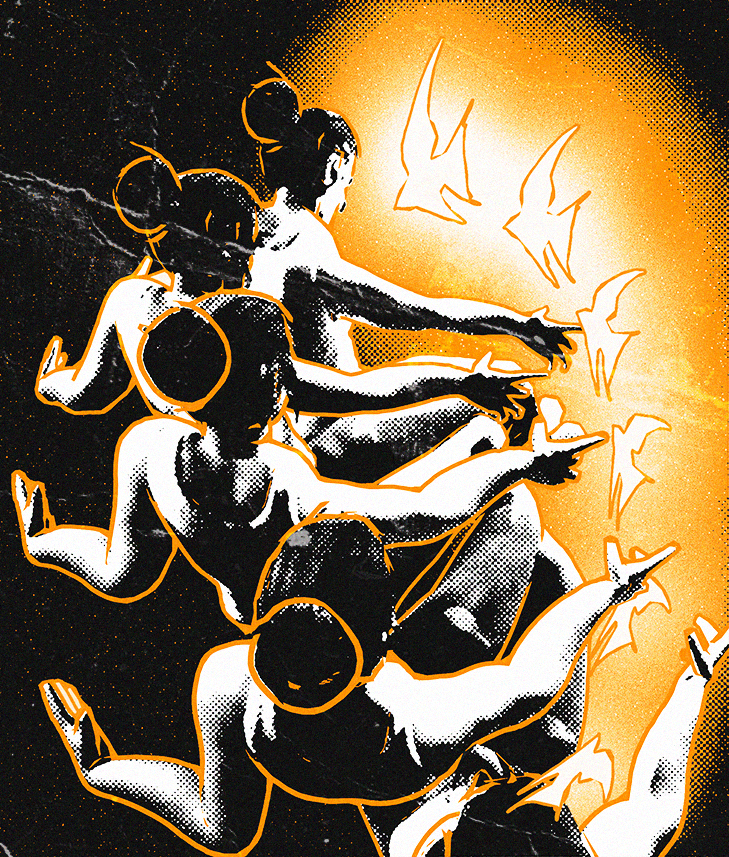
by corgi
"Nobody's ever gonna kiss you if you smoke," Fray teases when Baj walks into the living room, lit cigarette in hand. "Like kissing an ashtray, man."
"No one's kissing me anyway. Are you serious?" They gesture to the tableau before them: Fray on his back on the rug, coffee table shoved out of the way. The TV's in front of him, and it is playing---"Is this jazzercise?"
"What if it is?" Fray says, and as if to prove it locks his hands behind his head and does an effortless sit-up.
Baj rolls their eyes. "It's not impressive when you do it."
"Wow! Mean!"
"I'm right," they say, and step over him. They mean to, anyway, and get halfway there when Fray grabs their pant leg. They stop, peering down at him.
The rush they get, seeing him under them, stuns them into stillness. Seeing him under them sweaty and with his hair down makes them go light-headed. It's not the first time he's done that to them, and it's not the first time Baj has firmly refused to interrogate that feeling. Then a grin slides onto his face and their stomach seizes.
"Hey," he says, and Baj blinks at him. "Nice view from down here."
"What does that mean?"
His face pinks, though the grin goes nowhere. "Nothing."
"Liar."
"Nothing!"
His fingers curl and uncurl in their pant leg. Baj looks at him. Eventually his grin wobbles, still there but self-conscious. "What, man?"
Baj is thinking about the smell of Fray's hair. They are thinking about that time a few days ago when he crawled into their bed after he thought they were asleep and back out before he thought they were awake. He'd gotten close enough that they could feel his breath, and they had spent all night terrified to move lest they disturb him. They had wanted to roll over and---and what?
"Kai?" Fray says, more timidly.
Baj asks, "Have you ever kissed an ashtray?"
"What? No!"
"Then how do you know it's that bad?" they ask. With that, with Fray staring dumbly at them, they take a drag off their cigarette and make for the back door.
Sometimes, rarely, Baj talks to their passenger. Out loud, as if talking to a mirror, practicing. On that trip to the lake, April had impressed upon them a need to get comfortable with it. They just needed to set the terms and talk to the thing. At first this pissed them off, but the more they think about it, the more it just makes sense. The thing reacts to their inner thoughts, anyway, so it's not like they have to find words. It certainly never uses them.
But, sometimes, talking just feels like the right thing to do.
They lay alone (but not) in one of April's dusty guest rooms. One of the tapes Fray got them ages ago whirs in the Walkman clutched to their chest, the others piled on the bed next to them. Sound thumps through their pair of shitty headphones. They know their passenger is already aware of what they're trying to say, but they have to admit it to themselves first. They pick through the lumpy patterns on the ceiling for anything that might help.
The buttons on their tape player are already loose from months of fidgeting, so they're careful as they run their fingers over the plastic. Their other hand is busying itself with the thin headset wire, fallen across their neck and shoulder. Say it. Say it. Say it.
"I think you need a name," they say, finally. Their voice sounds different like this, just vibration under the clear song. The thing's answer is simultaneous with the words: a purring curiosity and eagerness that fills up their chest, that spurs them forward.
"Do you-- I mean, you don't have one, right?" A settling feeling, a nesting feeling, a house-home-roost-you-you-you.
They flex their fingers around and around the wire, running others across the grooves and curves of the tape player.
"I've never named anything before." They've titled things, sure, but names are different. Names don't have anything to do with their subject, not in the way the title of a painting or a song does. Names stand by themselves. What do you even call a phoenix, anyway?
They can feel it, now, peering over their shoulder. A focused interest, a singular sort of nosiness that's familiar to them. They chew on their lip. What do you call a phoenix?
Nothing comes to mind, and the tape reaches its end. Distracted, they roll onto their stomach and paw through the pile of cassettes. They never considered an actual name for it, so focused on the trepidation of admitting it needs one, and their head feels empty now except for the warm roost-nest-you-you-wait-you feeling.
Eventually they settle on an old favorite, Paranoid, and go back to staring at the ceiling. They find themselves discomfited by the thing's patience with them. Will they find its name if they just wait? Will it tell them? Maybe it would have by now, if it were going to. They still don't know how this works. What do you call a phoenix?
They try a few random names, half-remembered from school, or novels, or movies. Speaking is starting to feel stupid, and again they worry at how patiently their passenger just waits.
Satan, laughing, spreads his wings! Oh Lord, yeah!
They snort at what comes to mind.
"Ozzy?"